When and Why Should You Consider Mediation in a Louisville Divorce?
Divorce mediation is not about convincing you to settle, avoiding court at all costs, or giving up important rights. It is one of several effective tools available to help resolve the issues that must be decided before your divorce can be finalized.
Every Kentucky divorce eventually reaches the same destination. Decisions must be made about parenting, child support, property division, business interests, retirement accounts, debts, spousal maintenance, and every other issue affecting your future. The question is not whether those decisions will be made. The question is who will make them.
When you and your spouse are able to reach an agreement through informed negotiation or mediation, you retain the opportunity to participate directly in shaping those decisions.
Agreement Preserves Your Ability to Shape the Outcome
When agreement cannot be reached, the responsibility shifts to the court, where a judge must decide the remaining issues based upon the evidence presented and Kentucky law.
Neither approach is inherently right or wrong. Some cases are well suited for mediation. Others ultimately require judicial resolution.
Preserving your opportunity to participate in these decisions does not require sacrificing important principles or accepting an outcome that fails to protect your future. The objective is not agreement at any cost. The objective is a resolution that protects what matters most to you and your family.
For more than twenty-five years, attorney Allen Dodd has helped clients evaluate when mediation is likely to move a case toward resolution, when additional preparation is necessary, and when litigation becomes the more appropriate path. Every case is different, but every important decision deserves careful preparation, sound legal guidance, and a clear understanding of the options available.
Attorney Insight
“Mediation is not about avoiding court. It is about preserving your opportunity to make important decisions about your own future before asking someone else to make those decisions for you. When agreement is possible, mediation can be an effective way to move a case forward. When it cannot resolve every issue you and your spouse disagree upon, your attorney must be fully prepared for whatever comes next.“ — Allen M. Dodd
If You and Your Spouse Cannot Reach an Agreement, Who Decides?
Every issue that the parties are unable to resolve must ultimately be
decided by the Court before your divorce can be finalized. The first
step to resolve any dispute is negotiation between the parties, or the
parties and their attorneys. When direct negotiation cannot resolve
every issue, the next step is often mediation, where the parties
continue negotiating with the assistance of a neutral mediator. If
mediation, negotiation, or other settlement efforts cannot resolve
every disagreement, the responsibility shifts to the Court.
Judges approach these decisions with professionalism, experience, and
a commitment to applying Kentucky law fairly. Their responsibility is
not to determine what either spouse wants most. Their responsibility is
to reach decisions that are legally sound, supported by the evidence,
and practical enough for the people who must live with them.
Unlike you and your spouse, however, the judge was not part of your
marriage. The Court has never watched you raise your children, managed
your family finances, operated your business, or experienced the
day-to-day realities of your life together. Judges must make important
decisions based upon the testimony, evidence, applicable law, and the
limited time available to hear your case.
One experienced family court judge described the responsibility this
way:
For many families, that perspective helps explain why mediation
deserves careful consideration. When an agreement can be reached
through thoughtful negotiation, you and your spouse retain the
opportunity to shape the decisions that will affect your family long
after the divorce is over. When agreement is not possible, the Court
provides the structure and authority necessary to bring the matter to a
final resolution.
Is Mediation the Right Option for My Divorce?
Mediation is an effective tool in many contested Kentucky and
Louisville divorces, but it is not the right solution for every client,
or every dispute. Its success depends less on whether you and your
spouse agree today, and more on whether meaningful progress toward
agreement is realistically possible.
Many people are surprised to learn that mediation can still be
productive even when communication has broken down, emotions are high,
or significant disagreements remain. Experienced mediators and
attorneys work through these challenges every day by helping both
parties focus on practical solutions instead of past conflicts.
Every question the parties answer together is one less question the
Judge must answer for them.
Mediation often works well when both spouses are willing to exchange
information honestly, discuss realistic options, and participate in
good-faith negotiations. Even if every issue is not resolved, narrowing
the areas of disagreement can reduce the time, expense, and uncertainty
associated with litigation.
There are situations, however, where mediation may be less effective or
additional safeguards become necessary. Cases involving domestic
violence, hidden assets, substance abuse, severe power imbalances, or a
complete refusal to participate in meaningful negotiations may
ultimately require greater Court involvement.
Likewise, when one spouse consistently uses intimidation, manipulation,
or controlling behavior to dominate every conversation, mediation
requires careful preparation and experienced legal guidance. The
purpose of mediation is not to change another person's behavior. It is
to determine whether important decisions can still be reached through a
structured process that protects your interests.
Every contested divorce presents its own challenges. One of the most
important responsibilities of an experienced divorce attorney is
helping clients recognize when mediation is likely to move the case
forward, when additional preparation is necessary, and when it is time
to prepare for the possibility that the remaining issues will need to
be decided by the Court.
The goal of mediation is not necessarily to resolve every issue in a
single session. The goal is to move your case forward whenever
meaningful progress can be made. Each agreement reached during
mediation preserves your ability to make important decisions about your
own future rather than leaving those decisions entirely to the Court.
Every agreement reached allows you and your spouse to retain a greater
measure of control over the decisions that will shape your future while
reducing the time, expense, uncertainty, and scope of the issues that
ultimately require judicial resolution.
What Happens During Divorce Mediation?
Mediation often feels unfamiliar because most people have never
participated in it before. Knowing what to expect can reduce
unnecessary anxiety and help you focus on what really matters—making
informed decisions that protect your future.
Although every mediation is different, most contested Kentucky divorce
mediations follow a similar progression.
Arrival and Preparation
Most mediation sessions begin with both parties, their attorneys
(when represented), and the mediator arriving at the scheduled time and
location. Before discussions begin, the mediator explains how the
process will work, establishes ground rules, answers procedural
questions, and ensures that everyone understands the purpose of the
session.
The objective is not to determine who is right or wrong. The objective
is to determine whether some or all of the remaining issues can be
resolved through informed discussion.
How Discussions Usually Take Place
Many people imagine mediation as spending an entire day sitting
directly across the table from their spouse. In reality, that is often
not how contested divorce mediation works.
In many cases, each party remains in a separate room while the mediator
moves between them, discussing proposals, clarifying concerns,
answering questions, and exploring possible solutions. This process
often allows productive negotiations to continue while reducing
unnecessary conflict and emotional confrontation.
Your Dodd & Dodd attorney remains with you throughout the process,
providing insight, options, legal advice, evaluating proposals,
explaining long-term consequences, and helping you make informed
decisions as discussions progress.
The Mediator's Role — And Our Attorney's Role
The mediator is a neutral professional whose responsibility is to
facilitate productive discussions. The mediator does not represent
either spouse, does not provide legal advice to either party, and
cannot force anyone to reach an agreement.
Your Dodd & Dodd attorney serves a very different purpose.
Throughout mediation, our attorney remains focused on protecting your
legal interests, helping you evaluate settlement proposals, identifying
potential problems, and making certain that any agreement reflects your
long-term objectives rather than the emotions of a single afternoon.
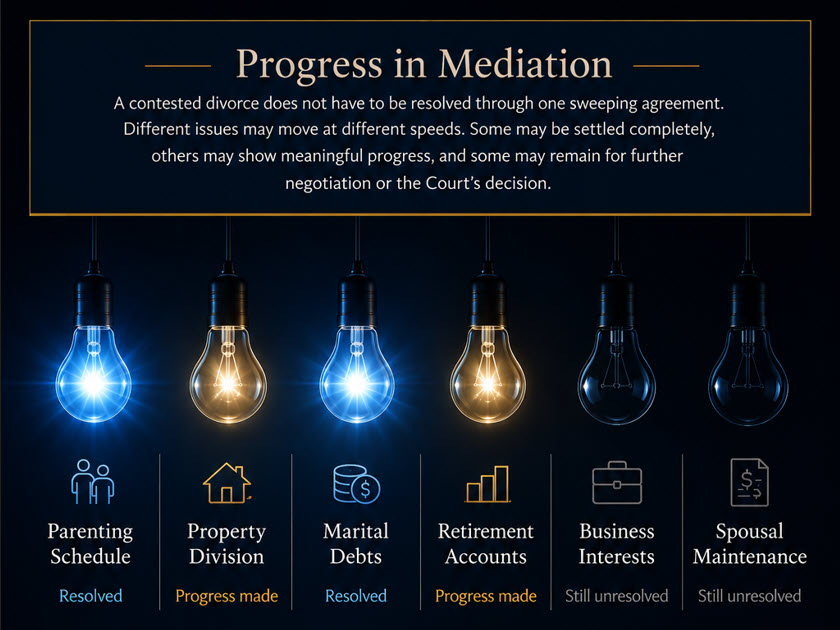
Progress Often Happens One Issue at a Time
One of the most common misconceptions about mediation is that every
issue must be resolved all at once.
That is rarely how meaningful progress occurs.
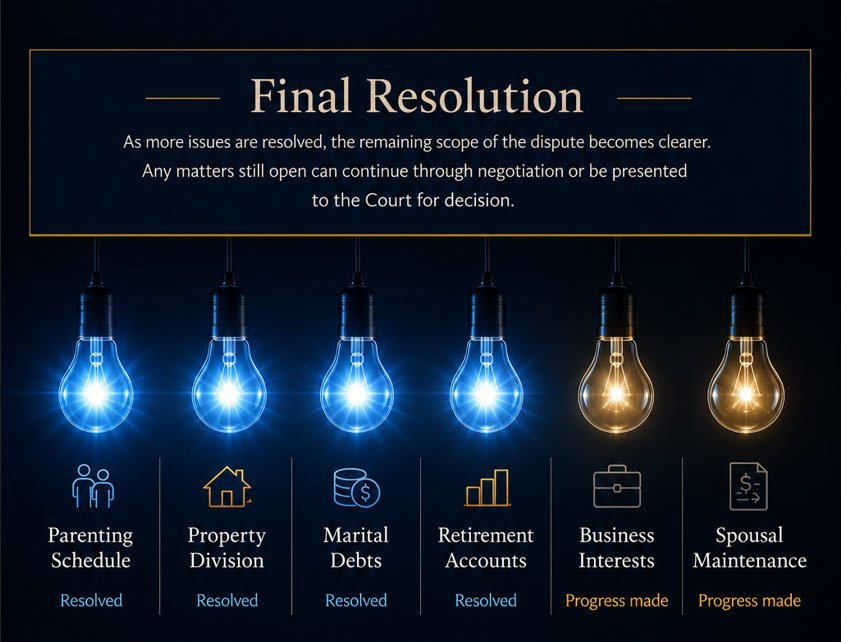
Instead, mediation often moves forward one issue at a time. Parenting
schedules may be resolved while property division remains under
discussion. Retirement accounts may be addressed before support issues
are finalized. Business interests may require additional information
while several other matters have already been successfully negotiated.
Each agreement narrows the remaining disputes.
Each question answered together is one less question that must
ultimately be decided by the Court.
Mediation Can End in Different Ways
Many people think mediation has only two possible outcomes: success of failure.
In reality, mediation is often far more productive than that.
Some mediations resolve every remaining issue, allowing the parties to finalize their settlement without further litigation.
Others resolve many important issues while leaving only a handful of disagreements for the Court to decide.
Sometimes mediation simply identifies the issues that genuinely cannot be resolved through negotiation, allowing everyone to move into the next phase of the case with greater understanding and focus.
Each of these outcomes represents progress.
Attorney Insight
People often expect mediation to produce one dramatic breakthrough moment.
In reality, meaningful progress usually happens one conversation at a time. Resolving even a few important issues can significantly reduce the time, expense, uncertainty, and emotional strain that often accompany any divorce. Every issue resolved through mediation allows you to retain greater control over the decisions that will shape your future.
— Allen M. Dodd
You Have Questions. Most People Do. You Need Answers.
If you are considering divorce mediation, you are probably asking yourself a lot of questions right now. That’s completely normal. Most people have never participated in mediation before, and the decisions you make can affect your children, your finances, your business, your retirement, your taxes, and your future.
For nearly thirty years, attorney Allen Dodd has helped individuals and families navigate these same concerns. Although every situation is different, many people come to us with remarkably similar questions.
About the Mediation Process
Will I have to be in the same room as my spouse?
What does a mediator actually do?
How long does mediation usually take?
What happens if we cannot reach an agreement?
Is mediation confidential?
Is anything we discuss legally binding?
About Protecting Yourself
Will I be pressured into accepting an agreement?
What if my spouse is controlling, manipulative, or intimidating?
What if I disagree with the mediator?
Can I leave mediation if I feel uncomfortable?
How do I know whether a proposed agreement is actually fair?
Why You Need an Attorney During Mediation
If the mediator is neutral, who is protecting my interests?
Should my Dodd & Dodd attorney attend mediation with me?
Can my Dodd & Dodd attorney review an agreement before I sign it?
How do I know whether I’m giving up important legal rights?
About Your Children
How are parenting schedules decided?
Can we create our own parenting plan?
What if we disagree about custody or decision-making?
Will our children be involved in mediation?
About Your Financial Future
What if my spouse is hiding assets or income?
How will our home, retirement accounts, investments, or business be divided?
What are the tax consequences of the decisions we make during mediation?
Could an agreement that appears fair today create unexpected financial or tax problems later?
How do we make sure today’s agreement continues to work years from now?
One Question Many People Never Think to Ask:
How Will Taxes Affect the Decisions We Make During Mediation?
Many divorce agreements appear fair when they are signed.
Months or even years later, however, the tax consequences of
dividing retirement accounts, selling a home, transferring
business interests, allocating investment assets, claiming
dependents, or structuring support obligations can significantly
change the true financial impact of those decisions.
A settlement that appears equal on paper does not always produce
equal financial results after taxes are considered.
Two Real-World Examples
Example One
Dividing a Retirement Account
A married couple owns a
401(k) worth $250,000.
As part of the marital property division, each spouse is entitled
to $125,000 of that account.
There are two very different ways that division might occur.
One option is to divide the retirement account itself so that each
spouse receives a separate retirement account containing their
respective share. Because the funds remain within qualified
retirement accounts, the transfer generally does not create an
immediate income tax obligation.
Another option allows the receiving spouse to take their
$125,000 as a cash distribution instead of leaving
those funds in a retirement account.
While that may seem attractive in the moment, the distribution
becomes taxable income to the spouse receiving the funds. Depending
upon that person's income and tax situation, a substantial portion
of the distribution may ultimately be lost to federal and state
income taxes.
The retirement account was divided equally.
The taxes were not.
Example Two
Two Investment Accounts That Look Identical
Now consider two investment accounts.
Each has a current value of
$175,000.
On paper, they appear to be exactly the same.
Account A
Current Value:
$175,000
Cost Basis:
$100,000
Account B
Current Value:
$175,000
Cost Basis:
$38,000
The difference is the cost basis—the amount
originally invested in each account.
When those investments are eventually sold, capital gains taxes
are based on the difference between the selling price and the
investment's cost basis.
Although both accounts have exactly the same current value,
Account B contains nearly twice the built-in taxable gain.
That means the spouse receiving Account B may ultimately owe
substantially more in capital gains taxes than the spouse receiving
Account A—even though both accounts appeared to be worth exactly
the same amount when the divorce settlement was signed.
Two accounts. The same value. Very different after-tax results.
Why This Matters
Attorney Allen M. Dodd brings a perspective that few
family law attorneys possess. In addition to nearly thirty years of
experience handling complex divorce and family law matters, he also
holds a Master of Laws (LL.M.) in Taxation, one of the
most advanced legal degrees available in the study of federal taxation.
That additional training allows him to evaluate not only whether a
proposed agreement appears fair today, but also how it may function
after taxes, transfers, reporting requirements, and future financial
obligations are taken into account.
When retirement accounts, closely held businesses, investment
portfolios, executive compensation, investment property, or other
significant financial assets are involved, understanding the tax
consequences before an agreement is signed can help
prevent costly surprises later.
Allen M. Dodd
Attorney at Law
Master of Laws (LL.M.) in Taxation
Frequently Asked Questions About Divorce and Family Law Mediation
Every family, every marriage, and every divorce presents unique circumstances. While no FAQ can answer every question, these are some of the concerns Attorney Allen M. Dodd hears most often from individuals considering mediation or navigating a contested divorce.
Do I Need My Own Attorney During Mediation?
Yes. The mediator serves as a neutral facilitator and cannot provide legal advice to either spouse. Your attorney represents your interests, helps you evaluate settlement proposals, explains the legal and financial consequences of important decisions, and helps ensure that any agreement reflects your long-term objectives.
Will I Have to Sit in the Same Room as My Spouse?
Not necessarily. In many contested divorces, each spouse remains in a separate conference room while the mediator moves between them, discussing proposals, identifying areas of agreement, and helping negotiations continue without unnecessary confrontation. This approach often allows productive discussions to move forward while reducing conflict.
What Happens If We Resolve Only Some of the Issues?
That is actually a common outcome. Every issue resolved through mediation reduces the number of questions that ultimately require the Court's decision. Even partial agreements can reduce the time, expense, uncertainty, and emotional strain associated with litigation.
Can Anyone Force Me to Accept a Settlement During Mediation?
No. The mediator cannot require either party to accept a proposal or sign an agreement. Mediation succeeds because both parties voluntarily decide whether a proposed resolution is acceptable.
What If I Believe My Spouse Is Hiding Assets?
Honest financial disclosure is essential to any meaningful settlement discussion. When legitimate concerns exist regarding hidden assets, incomplete financial information, or inaccurate disclosures, additional investigation, formal discovery, or court involvement may become necessary before an informed agreement can be reached.
What Happens If Mediation Does Not Resolve Everything?
Mediation is intended to move the case forward whenever meaningful progress can be made. If certain issues remain unresolved, those specific matters may ultimately be decided by the Court while preserving the agreements the parties have already reached.
How Long Does Divorce Mediation Usually Take?
Every family and every dispute is different. Some mediations resolve most issues in a single session, while others require additional meetings as information is gathered, proposals are evaluated, or financial issues are addressed. The timeline depends largely upon the complexity of the issues involved and each party's willingness to work toward resolution.
How Can I Prepare for Divorce Mediation?
Preparation often begins long before the mediation session itself. Understanding your financial circumstances, gathering important records, identifying your priorities, and discussing potential options with your attorney beforehand can help make the mediation process more productive and allow you to make informed decisions with greater confidence.
When to Speak With an Experienced Louisville Divorce Attorney at Dodd & Dodd
In many divorce cases, individuals wait to speak with an attorney until decisions have already been made or positions have been established. By that point, options may be more limited and certain issues more difficult to resolve.
In more complex situations—particularly those involving children, significant assets, business interests, or the potential for conflict—planning often begins months before a divorce is formally filed. Early decisions regarding financial structure, documentation, and communication can influence the direction of the case and the options available later.
Seeking the advice, guidance, and counsel of our attorneys helps clarify your unique situation, how to prepare, and identify potential risks before positions harden or conflict escalates.
If you are considering divorce or have been served with divorce papers, speaking with an experienced, proven Louisville divorce attorney at Dodd & Dodd allows you to understand your position, protect what matters most, and establish the best path forward.
Allen M. Dodd – Louisville Divorce Attorney
Divorce cases involving children, financial complexity, or contested issues require more than a general understanding of the law. They require experience in how these matters are evaluated, negotiated, and, when necessary, resolved in court.
Education: Brandeis School of Law (J.D., 1999); Washington University School of Law (LL.M. in Taxation, 2000)
Ratings: AV Preeminent® Peer Review Rated by Martindale-Hubbell®
Memberships: Louisville Bar Association; Kentucky Bar Association
Recognitions: Previously named “Top Lawyer” by Louisville Magazine
Divorce cases involving children, financial complexity, or contested issues require more than a general understanding of the law. They require experience in how these matters are evaluated, negotiated, and, when necessary, resolved in court.
Allen McKee Dodd is the lead Louisville divorce attorney at Dodd & Dodd Attorneys, PLLC, one of Kentucky’s oldest law firms, established in 1869. He brings more than 25 years of experience in family law and tax, with a practice focused on matters where the outcome carries long-term financial and personal consequences.
Allen is the co-author of Kentucky Domestic Relations Practice (2nd edition), one of the leading references used by family law attorneys throughout the state. He has served as Chair of the Family Law Sections of both the Kentucky Bar Association and the Louisville Bar Association, and currently serves as Vice-Chair of the Kentucky Bar Association Family Law Section.
In addition to his work in practice, he has presented extensively to the Louisville Bar Association, Kentucky Bar Association, and the University of Kentucky College of Law on topics including business interests in divorce, financial structuring, custody and relocation, and the intersection of tax and family law.
This level of experience becomes particularly important in cases involving complex financial issues, business ownership, or contested custody matters, where careful analysis, preparation, and courtroom experience can directly influence the outcome.
Contact an Experienced Louisville Divorce Attorney
The quality of your Louisville divorce attorney will have a substantial impact on the time and cost associated with your divorce, as well as how quickly you can see your life moving forward.
The decisions made during a divorce can affect your children, your financial position, and your long-term stability. Having a clear understanding of your options—and a structured approach to the process—can make a meaningful difference.
If you are considering divorce or have been served with divorce papers, contact Dodd & Dodd Attorneys, PLLC to speak with an experienced Louisville divorce attorney and begin moving forward with clarity and direction.
You deserve to have access to the best possible lawyers and the advice and legal knowledge that can only be obtained through decades of experience.


 Divorce mediation is not about convincing you to settle, avoiding court at all costs, or giving up important rights. It is one of several effective tools available to help resolve the issues that must be decided before your divorce can be finalized.

 About the Mediation Process
 About Your Children