

Kentucky Military Divorce Attorneys
Louisville Military Spouse Divorce and Family Lawyers
Welcome
 Understanding a military divorce often requires careful attention to retirement benefits, military benefits, parenting arrangements, deployment-related concerns, and financial issues that may continue long after the divorce is finalized.
As you review the information below, you remain in complete control of your timeline and decisions.
If this material raises questions, confirms a concern, or suggests that your situation may benefit from legal guidance, there are several ways to connect with our office at any time while you continue reviewing the information on this page.
- Direct Phone Access: Our office telephone number remains visible at the top of the page throughout your visit.
- Secure Inquiry: The Contact Us option in the menu provides a direct and private way to reach our office or request a return call.
- Schedule a Consultation: A consultation scheduling link is available at the top of this page if you would prefer to reserve a time to speak with an attorney.
You are encouraged to continue reading and use the information below to better understand the issues that may affect your situation. If you would like clarification regarding the specific facts of your case, we invite you to contact our office.
What Do You Need to Know About Military Divorce here in Louisville?

Military divorces involve many of the same issues present in other divorces here in Louisville, and throughout Kentucky. But military service can introduce additional considerations involving retirement benefits, healthcare eligibility, deployment, military compensation, and child custody arrangements.
Whether one spouse serves on active duty, in the reserves, or is retired from military service, decisions made early in the divorce process can affect long-term financial security, parenting arrangements, and future benefits.
Understanding how Kentucky divorce law and federal military regulations interact can help military families make more informed decisions as the process moves forward.
 Military divorces involve many of the same issues present in other Kentucky divorces, but military service can introduce additional considerations involving retirement benefits, healthcare eligibility, deployment, military compensation, and child custody arrangements.
Whether one spouse serves on active duty, in the reserves, or is retired from military service, decisions made early in the divorce process can affect long-term financial security, parenting arrangements, and future benefits.
Understanding how Kentucky divorce law and federal military regulations interact can help military families make more informed decisions as the process moves forward.
Three Important Things to Know About Military Divorce
Military Divorce Involves Both State and Federal Law
Kentucky courts handle military divorces, but federal laws may affect retirement division, military benefits, and procedural protections available to service members.
Military Retirement Benefits May Require Special Analysis
Military retirement benefits often represent one of the most valuable marital assets in a military divorce. How those benefits are evaluated and divided depends on the circumstances of the marriage and military service.
Deployment and Military Service Can Affect Parenting Plans
Military families often face unique challenges involving deployment, relocation, training obligations, and parenting schedules that may require careful planning during a divorce.
If You Are Facing a Military Divorce, You May Be Wondering…
If you are the spouse of someone who is serving or has previously served in the military, you may be concerned about:
 Whether military retirement benefits can be divided during a divorce
- Whether healthcare benefits or Tricare coverage may continue after divorce
- How the 20/20/20 Rule applies to your situation
- Whether deployment or military assignments will affect child custody and parenting time
- How military income, housing allowances, and benefits may affect support obligations
- Whether military disability benefits can be considered during property division
If you currently serve or have served in the military, you may have questions about:
- How military retirement benefits are treated during a Kentucky divorce
- Whether federal laws affect the division of military retirement pay
- How deployment or future military assignments may affect parenting arrangements
- How military compensation is evaluated for child support or maintenance purposes
- Whether a divorce can proceed while a service member is deployed
- How military benefits and future retirement planning may be affected
Military divorces often involve issues that do not arise in many civilian divorces. Understanding those issues early can help military families make informed decisions and avoid unnecessary complications as the process moves forward.
What Makes Military Divorce Different From Other Kentucky Divorces?
Military divorces are handled in Kentucky family courts, but military families may also face issues involving federal military laws, retirement benefits, healthcare eligibility, deployment obligations, and military compensation. Like other Kentucky divorce matters, issues involving property division, child custody, parenting time, child support, and spousal maintenance remain governed by Kentucky law.
For a broader discussion of the divorce process and how Kentucky courts address these issues generally, see our Louisville Divorce Attorney resource.
 Kentucky Law Governs The Divorce
Property division, child custody, parenting time, child support, and spousal maintenance are generally determined under Kentucky law.
Military Benefits May Require Additional Analysis
Military retirement benefits, healthcare eligibility, and certain military benefits may be affected by federal laws and military regulations that do not apply in most civilian divorces.
Military Service Can Affect Family Decisions
Deployments, relocations, and military assignments can influence parenting plans, custody arrangements, and other practical aspects of the divorce process.
Understanding these issues early helps military families make informed decisions regarding benefits, finances, and parenting arrangements before problems become more difficult to address.
Child Custody and Parenting During Military Service
Military service does not prevent a parent from maintaining a meaningful relationship with their children during or after divorce. Kentucky courts continue to evaluate custody and parenting arrangements according to the child’s best interests while recognizing the realities that military families may face.
Kentucky Courts Focus on the Child’s Best Interests

Kentucky law establishes a rebuttable legal presumption that it is in a child’s best interests to spend an equal amount of quality time with each parent during and after a divorce whenever appropriate. Military parents remain entitled to seek joint custody, shared parenting time, and meaningful involvement in their children’s lives. Military service alone does not determine the outcome of a custody case.
Courts often focus on factors such as stability, parental involvement, communication, the child’s needs, and the practicality of proposed parenting arrangements when determining what serves the child’s best interests.
Military Service Can Create Unique Parenting Challenges
 Military families may face circumstances that many civilian families never encounter, including:
- Deployments
- Temporary duty assignments
- Training obligations
- Relocations
- Permanent Change of Station (PCS) orders
- Extended periods away from home
These circumstances can make traditional parenting schedules difficult to maintain and may require greater flexibility when developing parenting plans.
Parenting Plans Should Reflect Military Realities
 Effective parenting plans often anticipate potential military obligations before they occur. Addressing issues such as deployment, communication with children during periods of service, transportation responsibilities, and temporary schedule adjustments can help reduce future conflict and uncertainty.
The goal is often to create arrangements that preserve the child’s relationship with both parents while remaining practical when military obligations arise.
Relocation and PCS Orders May Require Additional Planning
 Military families may experience relocations that significantly affect parenting schedules. When one parent receives PCS orders or must move because of military service, courts may need to evaluate how parenting time can be adjusted while continuing to serve the child’s best interests.
Because military assignments and relocations can occur long after a divorce is finalized, some families may later need to modify parenting arrangements to accommodate changing circumstances. Planning for these possibilities early can help reduce future conflict and uncertainty.
These situations often benefit from careful consideration of how future military obligations may affect custody arrangements and parenting schedules while preserving meaningful relationships between children and both parents.
Military Parents Can Remain Actively Involved in Their Children’s Lives
Military service can create logistical challenges, but many military parents maintain strong and meaningful relationships with their children throughout and after the divorce process. Thoughtful parenting plans, clear communication, and realistic expectations often help families navigate military obligations while preserving important parent-child relationships.
Understanding the 10/10 Rule, 20/20/20 Rule, and 20/20/15 Rule
Military spouses and service members often hear references to the 10/10 Rule, the 20/20/20 Rule, and the 20/20/15 Rule during a military divorce. These rules address different issues and are frequently misunderstood.
Importantly, these rules do not determine whether military retirement benefits may be considered marital property under Kentucky law. Instead, they generally affect how certain retirement payments and military benefits may be administered following a divorce.
The 10/10 Rule
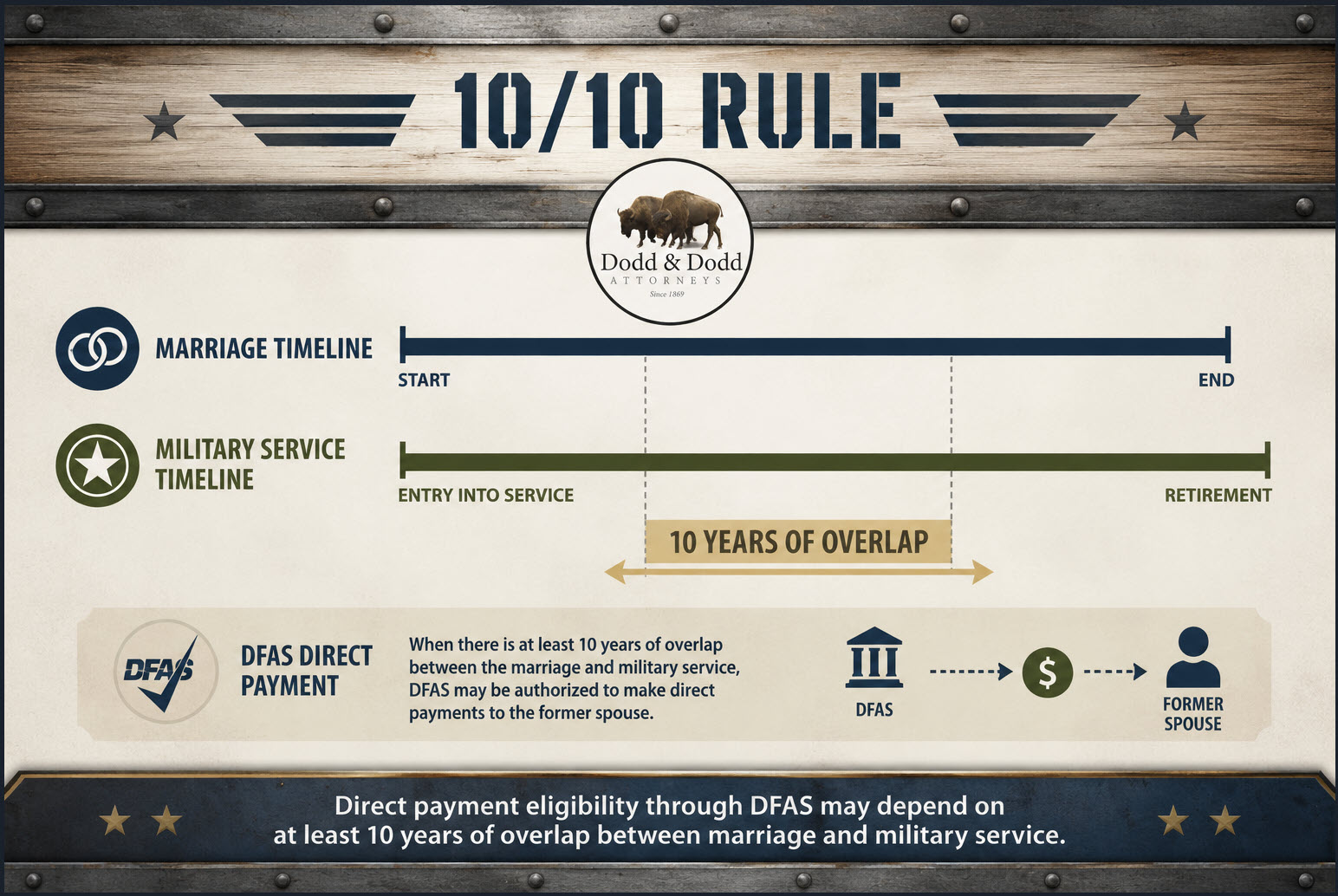 One of the most common misconceptions in military divorce is the belief that a spouse must have been married to a service member for at least ten years in order to receive a portion of military retirement benefits.
That is not what the 10/10 Rule provides.
The 10/10 Rule generally relates to payment administration through the Defense Finance and Accounting Service (DFAS). Under this rule, if the marriage overlapped at least ten years of the service member’s creditable military service, DFAS may be authorized to send qualifying retirement payments directly to the former spouse pursuant to a court order.
The rule does not determine whether military retirement benefits may be divided. Instead, it addresses whether direct payment through DFAS may be available.
The 20/20/20 Rule
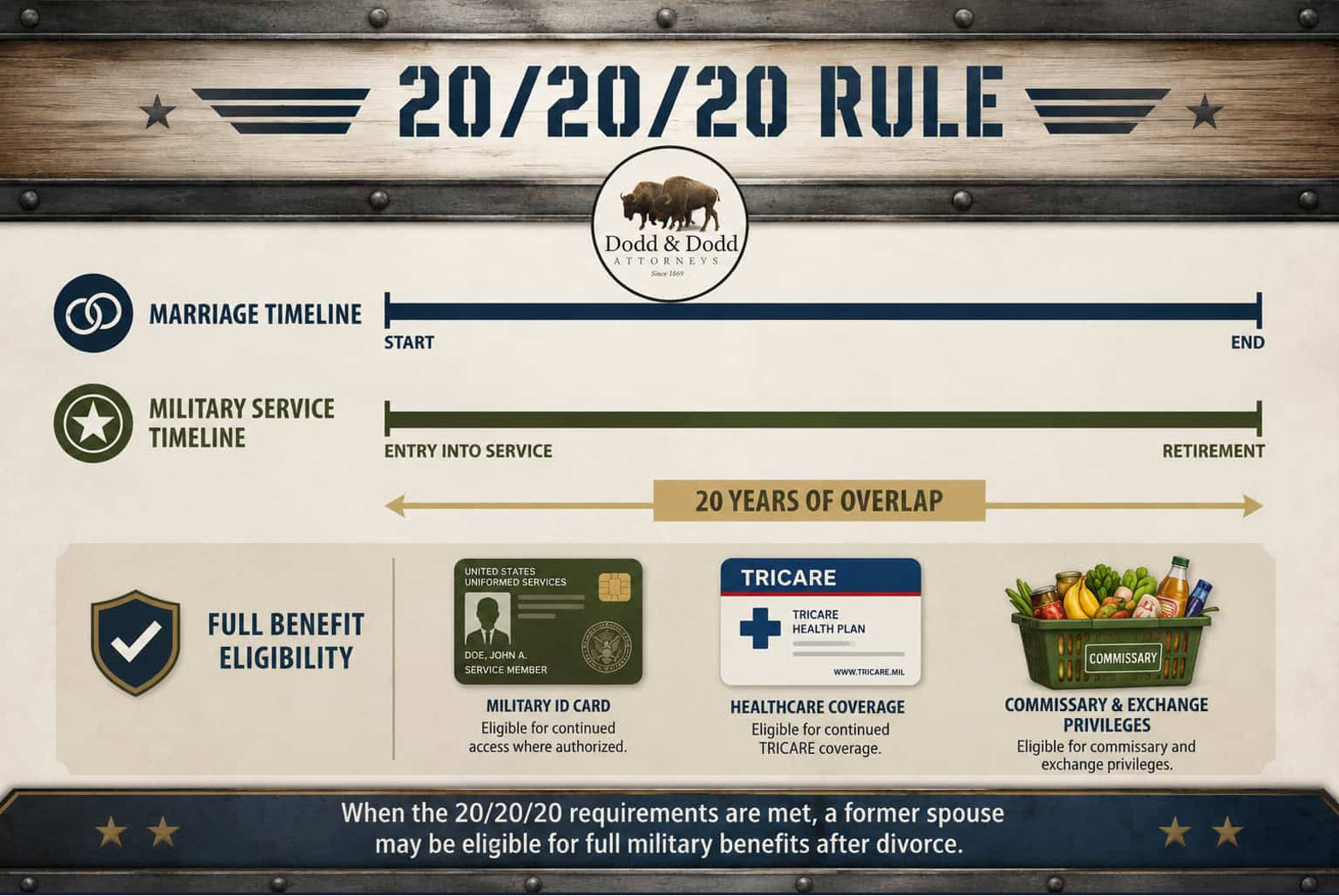 The 20/20/20 Rule addresses eligibility for certain military benefits following a divorce.
Generally, the rule requires:
- At least 20 years of marriage
- At least 20 years of creditable military service
- At least 20 years during which the marriage and military service overlapped
When these requirements are satisfied, a former spouse may remain eligible for certain military benefits after divorce, including:
- TRICARE healthcare coverage
- Commissary privileges
- Military exchange privileges
Because these benefits can have significant long-term value, military families often benefit from understanding eligibility requirements before finalizing a divorce.
The 20/20/15 Rule
Some military spouses narrowly miss qualifying under the 20/20/20 Rule. In certain circumstances, the 20/20/15 Rule may provide limited transitional healthcare coverage following divorce.
 Generally, the rule applies when:
- The marriage lasted at least 20 years
- The service member has at least 20 years of creditable military service
- At least 15 years of the marriage overlapped with military service
When these requirements are met, a qualifying former spouse may receive one year of transitional TRICARE medical coverage beginning on the date the divorce becomes final.
Unlike the 20/20/20 Rule, however, the 20/20/15 Rule does not generally provide ongoing commissary privileges, exchange privileges, or permanent healthcare eligibility.
The transitional TRICARE coverage is also subject to important limitations and may terminate earlier under certain circumstances, including remarriage or obtaining employer-sponsored health insurance coverage.
Understanding how these rules apply before a divorce is finalized can help military families evaluate retirement benefits, healthcare coverage, and other important considerations that may affect life after divorce.
Deployment and Military Divorce
Military service does not prevent a divorce from moving forward. However, deployments, training obligations, temporary duty assignments, and other military responsibilities can create practical and legal challenges that require additional planning.
Military families often benefit from understanding how deployment may affect divorce proceedings, parenting arrangements, court appearances, and future modifications before important decisions are made.
Can a Divorce Proceed During Deployment?
In many situations, a divorce may proceed even when a service member is deployed or stationed away from home. However, military service can affect scheduling, participation in court proceedings, the exchange of information, and the ability to respond to legal filings.
The specific circumstances of the deployment, the issues involved in the divorce, and the needs of the parties may all affect how the case proceeds.
The Servicemembers Civil Relief Act (SCRA)
 Federal law provides certain legal protections for active-duty service members through the Servicemembers Civil Relief Act (SCRA).
Depending upon the circumstances, these protections may allow courts to postpone or stay certain proceedings when military service materially affects a service member’s ability to participate in the case.
The purpose of these protections is not to prevent a divorce from occurring, but to help ensure that military service obligations do not unfairly interfere with a service member’s ability to protect his or her legal interests.
Parenting Arrangements During Deployment
Deployments and extended military assignments may require temporary adjustments to parenting schedules and custody arrangements.
Many military families benefit from parenting plans that anticipate deployment-related issues before they arise, including communication with children, temporary schedule changes, transportation responsibilities, and procedures for addressing unexpected military obligations.
Planning for these possibilities early can help reduce uncertainty and conflict if military assignments change in the future.
Future Military Assignments May Require Modifications
Military obligations do not end when a divorce decree is entered.
Future deployments, PCS orders, relocations, training assignments, and changes in military status may affect parenting schedules, custody arrangements, or other provisions contained in a divorce judgment.
In some situations, military families may need to revisit existing court orders and seek modifications that better reflect current circumstances while continuing to serve the child’s best interests.
Planning Ahead Can Reduce Future Conflict
Military families often face circumstances that can change with little notice. Considering potential deployments, relocations, and future military obligations during the divorce process can help create agreements that remain practical and workable as circumstances evolve.
Military Compensation, Child Support, and Maintenance
Military compensation can affect the calculation of child support and spousal maintenance in a Kentucky divorce. While military families are subject to many of the same support principles that apply to civilian families, military pay structures may involve compensation and benefits that require additional analysis.
Understanding how military compensation is evaluated can help military families make more informed decisions regarding financial obligations during and after divorce.
Military Compensation May Include More Than Base Pay
 Military compensation often extends beyond basic military pay.
Depending upon the circumstances, compensation may include:
- Base pay
- Basic Allowance for Housing (BAH)
- Basic Allowance for Subsistence (BAS)
- Special duty pay
- Incentive pay
- Bonuses and other military compensation
These forms of compensation may affect the evaluation of financial resources available to each party during a divorce.
Child Support Is Determined Under Kentucky Law
Kentucky child support obligations are generally determined using statutory guidelines that consider the financial circumstances of the parents and the needs of the child.
When one parent serves in the military, military compensation and benefits may be relevant when calculating income and support obligations.
The specific facts of each family, including parenting arrangements and income sources, can affect the final support determination.
Spousal Maintenance May Be Affected By Military Compensation
Military income may also be considered when evaluating requests for spousal maintenance.
Kentucky courts may consider a variety of factors when determining whether maintenance is appropriate and, if so, the amount and duration of any award.
Military compensation, earning capacity, financial resources, and the circumstances of the marriage may all be relevant depending upon the facts of the case.
Changes In Military Status May Affect Future Support Obligations
Military careers can involve promotions, deployments, reserve activation, retirement, disability status changes, and other events that affect income.
When significant changes occur, military families may need to evaluate whether existing support arrangements continue to reflect current circumstances.
In some situations, changes in income or family circumstances may justify seeking modification of existing support obligations through the court.
Understanding Military Compensation Early Can Prevent Future Disputes
Questions involving military compensation, support obligations, housing allowances, and future income changes are often easier to address when they are considered early in the divorce process.
A clear understanding of military compensation and its potential impact on child support and maintenance can help reduce misunderstandings and support more informed decision-making.
Military Divorce Issues Often Benefit From Early Planning
 Military divorces frequently involve considerations that do not arise in many civilian divorces, including retirement benefits, healthcare eligibility, military compensation, deployment obligations, and parenting arrangements affected by military service.
Understanding how Kentucky divorce law, federal military laws, and military regulations interact can help military families make informed decisions before important rights, benefits, or opportunities are affected.
Whether your concerns involve military retirement benefits, child custody, parenting time, deployment-related issues, healthcare eligibility, support obligations, or other military divorce matters, obtaining reliable information early can help clarify available options and reduce uncertainty.
Speak With Louisville Divorce Attorney Allen M. Dodd
Allen M. Dodd has represented Kentucky families in divorce and family law matters involving military service members, military spouses, retirement benefits, custody disputes, parenting issues, and complex property division concerns.
If you have questions about a military divorce in Kentucky, contact Dodd & Dodd to discuss your circumstances and learn more about your available options.
We invite you to review the strong recommendations of our former clients and the legal industry and contact Dodd & Dodd or call 502-584-1108 to schedule an appointment with one of our experienced divorce and family law attorneys.