



Divorce is not a single decision. It is a legal process that affects your children, your financial position and interests, as well as your long-term stability. The decisions made early in that process—what is documented, how issues are approached, and how conflict is handled—can influence the outcome in lasting ways.
Many individuals begin looking for information after the situation has already become difficult. In some cases, there are disagreements about parenting, finances, or control of assets. In others, the issues are more complex, involving business interests, retirement accounts, or long-term financial needs and planning. Understanding how these issues are handled under Kentucky law allows you to make informed decisions and avoid missteps that can affect your position.
This page provides a structured overview of how contested divorce works in Louisville and Jefferson County, including how Kentucky courts approach property division, child custody, financial support, and the resolution of contested issues. It is designed to help you understand what matters, how the process unfolds, and where careful planning and proven strategies can and will make a meaningful difference.
Understanding Divorce Law in Kentucky
 Kentucky is a no-fault divorce state. A marriage may be dissolved when the relationship is considered “irretrievably broken,” without the need to prove wrongdoing by either spouse.
If one intends to file for divorce in Kentucky, one of the spouses must have lived in the state for a minimum of 180 days. Divorce actions are filed in the appropriate Family Court, such as the Jefferson County Family Court, for individuals in Louisville.
Kentucky law requires a minimum waiting period before a divorce can be finalized. In most cases, a divorce cannot be completed until all issues have been resolved, including property division, financial support, and, where applicable, child custody and parenting arrangements.
When spouses are able to reach an agreement on these issues, the process can move more efficiently. When disagreements arise, the court may be required to resolve one or more issues based on the specific facts of the case and the surrounding circumstances.
Understanding how Kentucky law structures the divorce process provides a foundation for making informed decisions, particularly when financial, parenting, or contested issues are involved.
Child Custody and Visitation or Parenting Time in a Louisville Divorce

When children are involved, decisions regarding custody and visitation or parenting time often become the most important and, in many cases, the most contested aspects of a divorce.
Kentucky law is guided by the “best interests of the child” standard. Courts begin with the (rebuttable) presumption that children benefit from meaningful relationships with both parents, and most cases should begin the conversation with joint custody and shared visitation or parenting time where appropriate.
Custody decisions generally involve two components. Legal custody refers to the authority to make major decisions affecting a child’s upbringing, including education, healthcare, and other significant matters. Physical custody addresses where the child lives and how parenting time is structured between the parents.
In determining custody and parenting arrangements, courts evaluate factors such as the relationship between each parent and the child, the stability of each household, the parents’ ability to communicate and cooperate, and the child’s existing routines, activities, and relationships.
Visitation schedules in parenting plans are developed with these factors in mind, often establishing detailed schedules for time with each parent, including school routines, activities, holidays, and transportation responsibilities. The goal is not simply to create a new schedule, but to structure a plan that maintains continuity and supports the child’s best interests as consistently as possible.
Divorce Involving Military Service
 Divorces involving military service may introduce additional legal and logistical considerations, including jurisdictional issues, deployment-related custody matters, and the division of military benefits and pensions.
The process of a military divorce is governed not only by Kentucky family law, but by Federal “Master” Statutes such as the Uniformed Services Former Spouses’ Protection Act, and the Servicemembers Civil Relief Act.
Kentucky family law manages the process, residency, and the “equitable division” of marital assets. Federal laws supplement, and in some cases override state law in the specific context of a military divorce.
A common misconception in military divorce is the ’10/10 Rule.’ It is important to understand that this rule does not determine whether a former spouse is entitled to a portion of a military pension—under Kentucky’s equitable distribution laws, retirement benefits are generally considered marital property. Rather, the 10/10 rule dictates how those benefits are paid; if the marriage lasted at least 10 years overlapping with 10 years of service, the former spouse can receive direct payments from DFAS rather than relying on the service member for monthly checks.
This is why you need an experienced military divorce attorney like Allen M. Dodd.
The complexity of a divorce is not defined by any single issue, but by how those issues interact and how they are addressed. Understanding where complications arise allows individuals to approach the process more deliberately and avoid unnecessary risk.
Division of Marital Property in Kentucky

One of the most significant aspects of any divorce involves the division of property and financial obligations accumulated during the marriage.
Kentucky follows an equitable distribution model. This means marital property is divided fairly, though not always equally, based on the circumstances of the marriage and each spouse’s financial position.
Under KRS 403.190, Kentucky is an equitable distribution state. This means the court is mandated to divide marital property in ‘just proportions’ without regard to marital misconduct. Applying KRS 403.190 to complex financial estates requires extensive experience and legal skill in both Kentucky family law and federal and state tax laws.
The court evaluates factors such as the contribution of each spouse—including homemaking—the duration of the marriage, and the economic circumstances of each party following the dissolution.
Marital property may include real estate, retirement accounts, business interests, investment accounts, and other assets acquired during the marriage, as well as debts. In many cases, the most important questions concern how these assets are characterized (marital property, separate property, or a blend of the two), valued, divided, and how those decisions affect each party’s long-term financial position.
When a divorce involves substantial assets, business ownership, or long-term financial planning, property division often becomes more complex and may require additional financial and legal analysis.

How Time and Cost Are Determined in a Louisville Divorce
We are often asked: “How long will the divorce take?” and “How much is this going to cost?”
The time required to complete a divorce and the overall cost of the process are directly related to the amount of disagreement between the spouses. When individuals are able to work through decisions and resolve issues efficiently, the process can move more quickly. When disputes involve parenting, financial matters, or control of assets, the process often becomes longer and more expensive.
Some divorces can be completed in a matter of weeks. Others may take a year or more. The difference is not defined by a single issue, but by how the issues are handled and the ability of the parties to reach resolution.

Child Support in a Louisville Divorce
Child support in Kentucky is determined using established guidelines designed to ensure that children continue to receive appropriate financial support from both parents.
These guidelines consider several factors, including each parent’s income, the number of children involved, the amount of visitation or parenting time, and certain expenses, such as health insurance and childcare.
While the guidelines provide a structured starting point, child support is not always a fixed number. Courts may adjust support obligations based on the specific circumstances of the case, particularly when income varies, expenses are significant, or parenting arrangements differ from standard assumptions.
Changes in circumstances after a divorce—such as a change in income, employment, or custody arrangements—may also justify a modification of child support.
Understanding how child support is calculated helps parents anticipate financial responsibilities and avoid misunderstandings as the process moves forward.
Spousal Maintenance (Spousal Support / Alimony) in a Louisville Divorce

In some divorces, one spouse may request financial support from the other at the beginning of the divorce process. Under Kentucky law, this is referred to as spousal maintenance, often described as spousal support or alimony.
Maintenance is not automatically awarded. Courts first determine whether one spouse lacks sufficient property or income to meet their financial needs (within reason) and is unable to support themselves through appropriate employment.
Maintenance may be awarded as a “temporary” order during the divorce process to help maintain financial stability while the case is pending. Toward the conclusion of the case, the court may enter a longer-term “permanent” maintenance order that applies going forward.
“Permanent” maintenance does not necessarily mean indefinite support. In many cases, the court will establish a defined period of time intended to allow the receiving spouse to become self-sufficient. The duration and amount of support are influenced by factors such as the length of the marriage, each spouse’s financial resources, and whether one spouse reduced or left employment to support the household or raise children.
Because these determinations are fact-specific, the structure and duration of maintenance varies in each case based on the circumstances involved.
The Divorce Process in Jefferson County
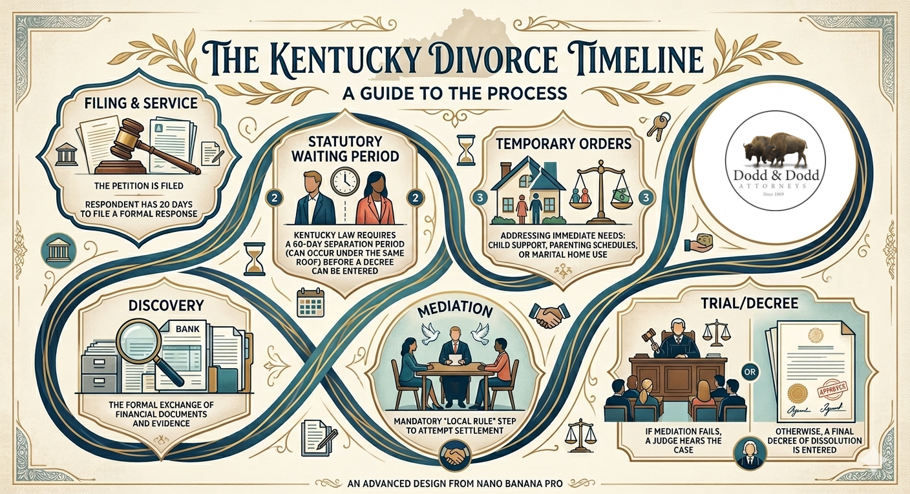
Jefferson County is fortunate to have ten separate Divisions focused exclusively on Family Law. In smaller counties family law, criminal matters and other cases are all heard by Circuit court.
The divorce process here in Louisville and throughout Jefferson County follows a defined legal sequence. While each case is different, most divorces include the following stages:
Filing the Petition for Dissolution of Marriage
One spouse files legal documents requesting the court to dissolve the marriage.

Service of Process
The other spouse is served with formal notice of the filing and given a fixed amount of time to respond.
Temporary Orders
The court may enter temporary orders addressing child custody, visitation and parenting time, financial support, and the use of marital property while the case is pending.
Discovery and Financial Disclosure
A critical phase of the Jefferson County divorce process is the formal exchange of information. We utilize Forensic Accounting techniques to ensure a transparent financial baseline is established before mediation or trial, protecting our clients from the risks of hidden or undervalued assets.
Both parties are required to exchange financial information, including income, assets, and debts, through formal disclosure. This allows for a complete and accurate evaluation of financial issues. These disclosures must be thorough, accurate, and truthful. Failure to provide full and transparent financial information can result in serious consequences, including court-imposed sanctions.
Negotiation or Mediation
Many issues can be resolved through negotiation or mediation, allowing the parties to reach an agreement on a given issue without the need for trial.
Our Local Rue 704 requires mandatory mediation before any contested matter is brought before the Judge. This can help to achieve an effective settlement while reducing the time, uncertainties, and expense of taking the matter before the Court.
Trial and Final Judgment
Allen M. Dodd is an experienced and effective trial attorney. This experience helps to protect your goals and interests when a matter of consequence is important to you.
If the parties are unable to resolve all issues, the court may conduct hearings or a trial and issue final decisions. A divorce cannot be finalized until all issues—custody, property division, and financial support—have been fully resolved.
We are also experienced in handling divorce cases involving prenuptial and post-martial agreements as well as domestic violence.
When to Speak With an Experienced Louisville Divorce Attorney at Dodd & Dodd

In many divorce cases, individuals wait to speak with an attorney until decisions have already been made or positions have been established. By that point, options may be more limited and certain issues more difficult to resolve.
In more complex situations—particularly those involving children, significant assets, business interests, or the potential for conflict—planning often begins months before a divorce is formally filed. Early decisions regarding financial structure, documentation, and communication can influence the direction of the case and the options available later.
Seeking the advice, guidance, and counsel of our attorneys helps clarify your unique situation, how to prepare, and identify potential risks before positions harden or conflict escalates.
If you are considering divorce or have been served with divorce papers, speaking with an experienced, proven Louisville divorce attorney at Dodd & Dodd allows you to understand your position, protect what matters most, and establish the best path forward.


Contact an Experienced Louisville Divorce Attorney
The quality of your Louisville divorce attorney will have a substantial impact on the time and cost associated with your divorce, as well as how quickly you can see your life moving forward.
The decisions made during a divorce can affect your children, your financial position, and your long-term stability. Having a clear understanding of your options—and a structured approach to the process—can make a meaningful difference.
If you are considering divorce or have been served with divorce papers, contact Dodd & Dodd Attorneys, PLLC to speak with an experienced Louisville divorce attorney and begin moving forward with clarity and direction.
You deserve to have access to the best possible lawyers and the advice and legal knowledge that can only be obtained through decades of experience.
We invite you to review the strong recommendations of our former clients and the legal industry and contact Dodd & Dodd or call 502-584-1108 to schedule an appointment with an experienced Louisville divorce lawyer. Our attorneys work to protect your privacy, while accomplishing the goals and objectives that are most important to you.
- Credit cards accepted • Available evening and weekends by appointment •